4.2.1Does the lower bound matter?

Deriving "Area Functions"
4-40.

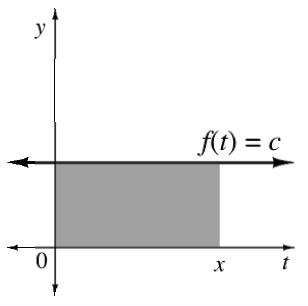
First quadrant, unscaled x axis labeled, t, with one tick mark, labeled x, 3 fourths of the way right, horizontal line labeled, f of t = c, about 1 third up, with shaded region below line & left of x axis tick mark.Determining slope functions is powerful because they offer the ability to express the rate of change of a function for all values of x in the domain. However, what about the area under a function? How can we also write an area function, A, that will calculate the area for all values t in the domain?

Calculate the areas of the following regions:

  1. A(0)=005dt

  2. A(1)=015dt

  3. A(2)=025dt

  4. A(x)=0x5dt

  5. Generalize your findings for the area under the curve of any constant function. That is, write an area function, A(x), that is equal to 0xcdt where c is a constant.

4-41.

First quadrant, unscaled x axis labeled, t, with one tick mark, labeled x, 3 fourths of the way right, increasing line labeled, f of t = 4 t + 5, passing through the point (0, comma 5), with shaded region below line & left of x axis tick mark.What if f is not a constant function? Examine the graph of the linear equation f(t)=4t+5 at right.

  1. What can the equation A(x)=0x(4t+5)dt be used to calculate?

  2. Use A(x)=0x(4t+5)dt to evaluate A(2) and A(9).

  3. Use A(x)=0x(4t+5)dt to write an equation for A(x).

  4. Generalize A(x)=0x(mt+b)dt. What is the significance of mt+b?

4-42.

First quadrant, unscaled x axis labeled, t, with tick mark labeled 2, half way right, & tick mark, labeled x, 3 fourths of the way right, increasing line labeled, f of t = 4 t + 5, passing through the point (0, comma 5), with shaded region below line, right of 2 & left of x. Does it matter what the lower bound of the integral is? What if the lower bound is not 0, but instead is another constant?

  1. Discuss with your team how the area under the curve changes as the lower bound changes. Test your conjecture by comparing functions A and B below.
    A(x)=0x(4t+5)dt        B(x)=2x(4t+5)dt

  2. Using a method similar to that used in part (c) of problem 4-29, write an equation for the area function, B. Then, compare it to the equation of A

  3. Demonstrate algebraically that B(x)=2x(4t+5)dt=A(x)A(2). Also demonstrate this relationship geometrically using area.

  4. Do the two area functions grow at the same rate? Does A(x)=B(x)? Is this true? Why or why not? 

  5. Write an equation using A(x) to evaluate G(x)=cx(4t+5)dt. Explain geometrically what G measures. 

Review and Preview problems below

4-43.

Review your results from the Freeway Fatalities problem in Chapter 1. Write a complete statement describing the relationship between the distance of the truck from home and its velocity. How can we determine the distance traveled from the velocity vs. time graph? How can we determine the velocity from the distance vs. time graph? Homework Help ✎

First quadrant, x axis labeled, time, hours, scaled from 6 to 12,  y axis labeled, speed of truck mph, scaled from 0 to 60, with continuous curves turning at approximate points as follows: starting at (6, comma 0), (6.7, comma 60), (7.3, comma 50), (8.5, comma 50), (9.2, comma 0), (10, comma 60), (10.7, comma  0), (11.5, comma 40), stopping at (12, comma 0).First quadrant linear, x axis labeled, time, hours, scaled from 8 to 4, y axis labeled, distance traveled, miles, scaled from 0 to 150, with continuous segments turning at the following points: starting at (8, comma 0), (9, comma 50), (10.5, comma 50), (11, comma 100), (11.75, comma 25), (2, comma 30), (3, comma  130), (4, comma 0).

4-44.

What is the general antiderivative, F, for each function, f, below? Homework Help ✎

  1. f(x)=cos(x)

  2. f(x)=2x2

  3. f(x)=9x1/3

4-45.

Use a Riemann sum with 20 rectangles to approximate the following integrals. Then use the numerical integration feature of your graphing calculator to check your answers. Homework Help ✎

  1. 04(24x3/2)dx

  2. 184x+3dx

4-46.

Explain why there are an infinite number of antiderivatives for each function. Demonstrate this fact with an example. Homework Help ✎

4-47.

Use the Power Rule to write an equation for f given f(x)=(x2+1)(x4) by first expanding f. Then, write the equation of the line tangent to f at x=3. Homework Help ✎

4-48.

If h(x)=f(x)·g(x), then does h(x)=f(x)·g(x)? Test this idea with h(x)=(x2+1)(x4) using your results from problem 4-47. Thoroughly record your results. Homework Help ✎

4-49.

Given each function h below, define functions f and g so that h(x)=f(g(x)). (Note: f(x)x and g(x)x) Homework Help ✎

  1. h(x)=sin(x2)+1

  2. h(x)=(3x312)2+2

4-50.

If n is a positive integer write an integral to represent limn1n[1(1n)+1(2n)++1(nn)]. Homework Help ✎

4-51.

What is the equation of the vertical line that will divide 065dxin half? Is this the same line that will divide 065xdx in half? Homework Help ✎
